
Charge Table of Elements
Many elements form ions with a predictable charge, but others — especially transition metals — can have several. This table lists the common oxidation states of the main elements, highlights which charges are most typical, and shows how to name each ion in the modern Stock system and with older -ous and -ic names. Practise naming with the tool.
- Free to use
- No sign-up
- Runs in your browser
Quick answer
A periodic table of charges shows the ion charges elements most often form, not a permanent electric charge for every atom. Neutral atoms have charge 0; ions become charged by losing or gaining electrons. Most Group 1 metals form +1, Group 2 form +2, aluminum forms +3, oxygen and sulfur often form −2, halogens form −1, and transition metals such as iron can be +2 or +3.
Oxidation state lookup and ion namer
Naming practice
Ion Charges & Naming Pack
Printable charge table of the elements, a transition metal naming reference (Stock and -ous/-ic names), a polyatomic ions sheet and two naming worksheets with answer keys.
- Charge table (PDF/XLSX)
- Naming reference (PDF)
- Polyatomic ions (PDF)
- Naming worksheet (PDF, DOCX)
- Oxidation states (PDF, DOCX)
Formats: PDF, XLSX, DOCX. Instant download after payment (link valid 72 hours, up to 5 downloads). AI-assisted: the templates were drafted with AI help and reviewed and laid out before publishing.
$5.00 USD, one-time 5 files · about $1.00 each
- Instant download
- 7-day refund
- Secure checkout by Stripe
7-day money-back guarantee. Full refund within 7 days of purchase, even after you download.
Free sample: Charge Table of Elements (PDF, 86 KB)
Full refund within 7 days — see the refund policy and license.
Free printables
Single sheets you can print right now, no sign-up. The full pack adds every sheet in one download plus the editable files.
 Printable Ion Naming Worksheet
 Printable Oxidation State Worksheet
Periodic table charges at a glance
Use these common ion charges as a quick guide, then check variable-charge metals by element.
| Element or group | Common charge | Example ions | Naming note |
|---|---|---|---|
| Group 1 metals | +1 | Li⁺, Na⁺, K⁺ | No Roman numeral |
| Group 2 metals | +2 | Mg²⁺, Ca²⁺ | No Roman numeral |
| Aluminum | +3 | Al³⁺ | No Roman numeral |
| Zinc, cadmium | +2 | Zn²⁺, Cd²⁺ | No Roman numeral |
| Silver | +1 | Ag⁺ | No Roman numeral |
| Halogens | −1 | F⁻, Cl⁻, Br⁻ | Simple ions |
| Oxygen, sulfur | −2 | O²⁻, S²⁻ | O has exceptions |
| Iron | +2, +3 | Fe²⁺, Fe³⁺ | iron(II)/(III) |
| Copper | +1, +2 | Cu⁺, Cu²⁺ | copper(I)/(II) |
| Tin, lead | +2, +4 | Sn²⁺, Pb⁴⁺ | Roman numerals |
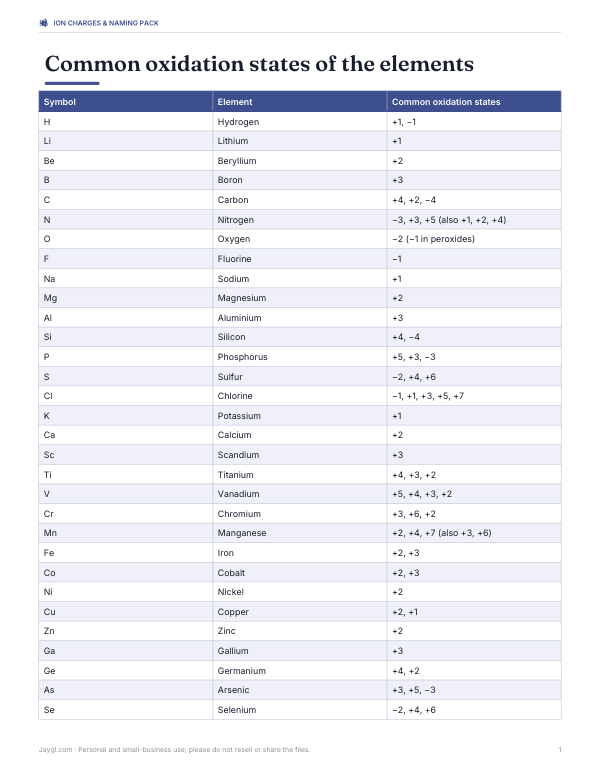
Common oxidation states
| Symbol | Element | Common oxidation states |
|---|---|---|
| H | Hydrogen | +1, −1 |
| Li | Lithium | +1 |
| Be | Beryllium | +2 |
| B | Boron | +3 |
| C | Carbon | +4, +2, −4 |
| N | Nitrogen | −3, +3, +5 (also +1, +2, +4) |
| O | Oxygen | −2 (−1 in peroxides) |
| F | Fluorine | −1 |
| Na | Sodium | +1 |
| Mg | Magnesium | +2 |
| Al | Aluminium | +3 |
| Si | Silicon | +4, −4 |
| P | Phosphorus | +5, +3, −3 |
| S | Sulfur | −2, +4, +6 |
| Cl | Chlorine | −1, +1, +3, +5, +7 |
| K | Potassium | +1 |
| Ca | Calcium | +2 |
| Sc | Scandium | +3 |
| Ti | Titanium | +4, +3, +2 |
| V | Vanadium | +5, +4, +3, +2 |
| Cr | Chromium | +3, +6, +2 |
| Mn | Manganese | +2, +4, +7 (also +3, +6) |
| Fe | Iron | +2, +3 |
| Co | Cobalt | +2, +3 |
| Ni | Nickel | +2 |
| Cu | Copper | +2, +1 |
| Zn | Zinc | +2 |
| Ga | Gallium | +3 |
| Ge | Germanium | +4, +2 |
| As | Arsenic | +3, +5, −3 |
| Se | Selenium | −2, +4, +6 |
| Br | Bromine | −1, +1, +5 |
| Rb | Rubidium | +1 |
| Sr | Strontium | +2 |
| Ag | Silver | +1 |
| Cd | Cadmium | +2 |
| Sn | Tin | +2, +4 |
| Sb | Antimony | +3, +5, −3 |
| I | Iodine | −1, +1, +5, +7 |
| Cs | Caesium | +1 |
| Ba | Barium | +2 |
| Pt | Platinum | +2, +4 |
| Au | Gold | +3, +1 |
| Hg | Mercury | +2, +1 (as Hg₂²⁺) |
| Pb | Lead | +2, +4 |
| Bi | Bismuth | +3, +5 |
| U | Uranium | +6, +4 |
The first value listed is usually the most common in everyday compounds. Oxidation states describe the charge an atom would have if all its bonds were ionic; for simple ions they equal the ion’s charge.
Patterns in the periodic table
| Group | Typical ion charge | Examples |
|---|---|---|
| 1 (alkali metals) | +1 | Li⁺, Na⁺, K⁺ |
| 2 (alkaline earth metals) | +2 | Mg²⁺, Ca²⁺, Ba²⁺ |
| 13 | +3 | Al³⁺ |
| 15 | −3 | N³⁻, P³⁻ |
| 16 | −2 | O²⁻, S²⁻ |
| 17 (halogens) | −1 | F⁻, Cl⁻, Br⁻, I⁻ |
| Transition metals | variable | Fe²⁺/Fe³⁺, Cu⁺/Cu²⁺ |
Main-group elements gain or lose electrons to reach the electron arrangement of the nearest noble gas. Transition metals lose their outer s electrons first and then varying numbers of d electrons, which is why they have several common charges.
Naming ions with more than one charge
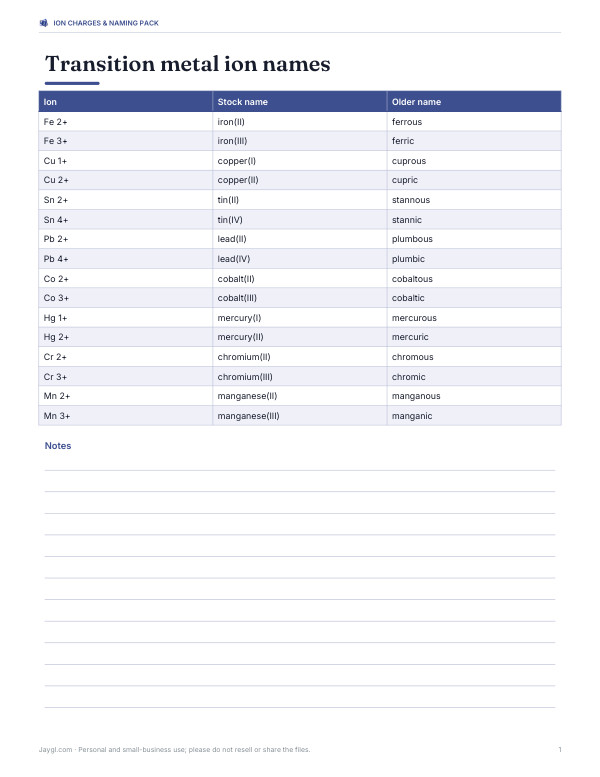
The Stock system puts the charge in Roman numerals in brackets after the metal’s name: Fe²⁺ is iron(II) and Fe³⁺ is iron(III). The older system used -ous for the lower charge and -ic for the higher, often with Latin roots: ferrous and ferric, cuprous and cupric, stannous and stannic. The Stock system is preferred today because it is unambiguous, but the older names still appear on product labels and in older texts.
Older -ous and -ic names
| Ion | Stock name | Older name |
|---|---|---|
| Fe²⁺ | iron(II) | ferrous |
| Fe³⁺ | iron(III) | ferric |
| Cu⁺ | copper(I) | cuprous |
| Cu²⁺ | copper(II) | cupric |
| Sn²⁺ | tin(II) | stannous |
| Sn⁴⁺ | tin(IV) | stannic |
| Pb²⁺ | lead(II) | plumbous |
| Pb⁴⁺ | lead(IV) | plumbic |
| Co²⁺ | cobalt(II) | cobaltous |
| Co³⁺ | cobalt(III) | cobaltic |
| Hg⁺ | mercury(I) | mercurous |
| Hg²⁺ | mercury(II) | mercuric |
| Cr²⁺ | chromium(II) | chromous |
| Cr³⁺ | chromium(III) | chromic |
| Mn²⁺ | manganese(II) | manganous |
| Mn³⁺ | manganese(III) | manganic |
How to use the tool
- Choose an element to see its common oxidation states.
- Pick a charge to see the ion symbol, Stock name and older name.
- Try the naming practice: choose the correct name for each compound.
- Remember: metals that only form one ion (Na⁺, Mg²⁺, Al³⁺, Zn²⁺, Ag⁺) don’t need Roman numerals.
Worked example
In FeCl₃, each chloride is Cl⁻, so three chlorides total −3; iron must be +3 to balance, making the compound iron(III) chloride — or ferric chloride in the older system. In FeO, oxide is O²⁻, so iron is +2: iron(II) oxide, or ferrous oxide. The same reasoning names Cu₂O as copper(I) oxide, because two copper ions balance one oxide.
Working out oxidation states in compounds
- Elements on their own have oxidation state 0.
- Oxygen is usually −2 (−1 in peroxides).
- Hydrogen is usually +1 (−1 in metal hydrides).
- Group 1 metals are +1 and group 2 metals +2 in compounds.
- The oxidation states in a neutral compound add up to 0; in an ion they add up to its charge.
For example, in the sulfate ion SO₄²⁻: 4 × (−2) = −8 for oxygen, so sulfur must be +6 to give an overall −2.
Why transition metals have several charges
Transition metals such as iron have electrons in two outer energy levels — the 4s and 3d orbitals — that are close in energy. Iron can lose its two 4s electrons to form Fe²⁺, or lose one more 3d electron to form Fe³⁺, which has a stable half-filled set of d orbitals. The conditions — oxygen, acidity, the other ions present — determine which forms. This is also why transition metal compounds are often coloured: electrons jump between d orbitals by absorbing visible light.
What the printable pack includes
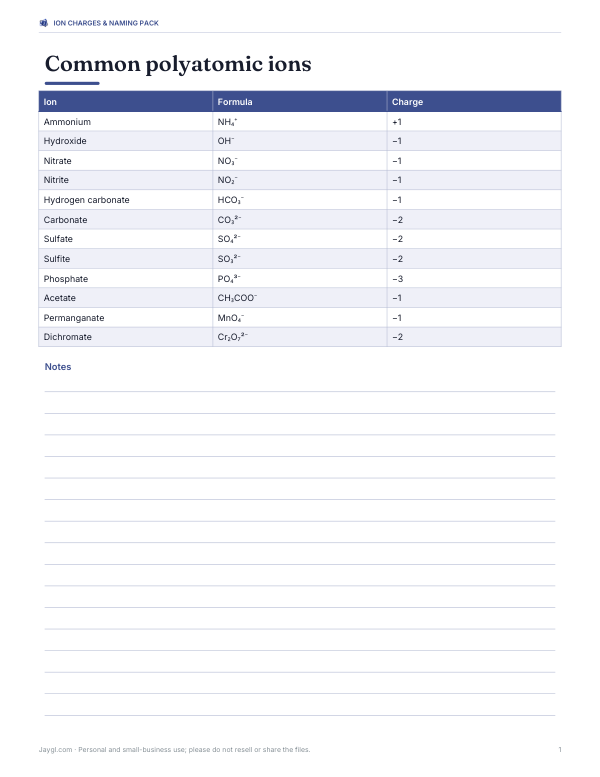
A printable charge table of the elements, a transition metal naming reference, a polyatomic ions sheet and naming worksheets with answer keys.
Frequently asked questions
Is electric charge on the periodic table the same as ion charge?
Usually, searchers mean ion charge. A neutral atom has no net electric charge, but the same element can form charged ions by losing or gaining electrons.
How do I read a periodic table of charges?
Start with the element’s group for main-group elements, then check the listed charge. For transition metals, use the compound formula or name because several charges may be common.
Why do some elements have more than one charge?
Some elements, especially transition metals, can lose different numbers of electrons. That is why iron can form Fe²⁺ and Fe³⁺, and copper can form Cu⁺ and Cu²⁺.
What is the charge of iron?
Iron commonly forms Fe²⁺ (iron(II)) and Fe³⁺ (iron(III)).
What does the Roman numeral in iron(III) mean?
The charge of the iron ion: +3.
What is the difference between ferrous and ferric?
Ferrous is Fe²⁺; ferric is Fe³⁺.
Which metals need Roman numerals?
Metals that form more than one common ion, such as iron, copper, tin, lead and cobalt.
What charge do halogens form?
Usually −1, as in chloride Cl⁻.
What is the charge of copper?
Copper commonly forms Cu²⁺ (copper(II)) and sometimes Cu⁺ (copper(I)).
What is the charge of aluminium?
Always +3 (Al³⁺) in its compounds.
What is the charge of silver?
Almost always +1 (Ag⁺).
Is anything uploaded?
No, it runs in your browser.